Introduction
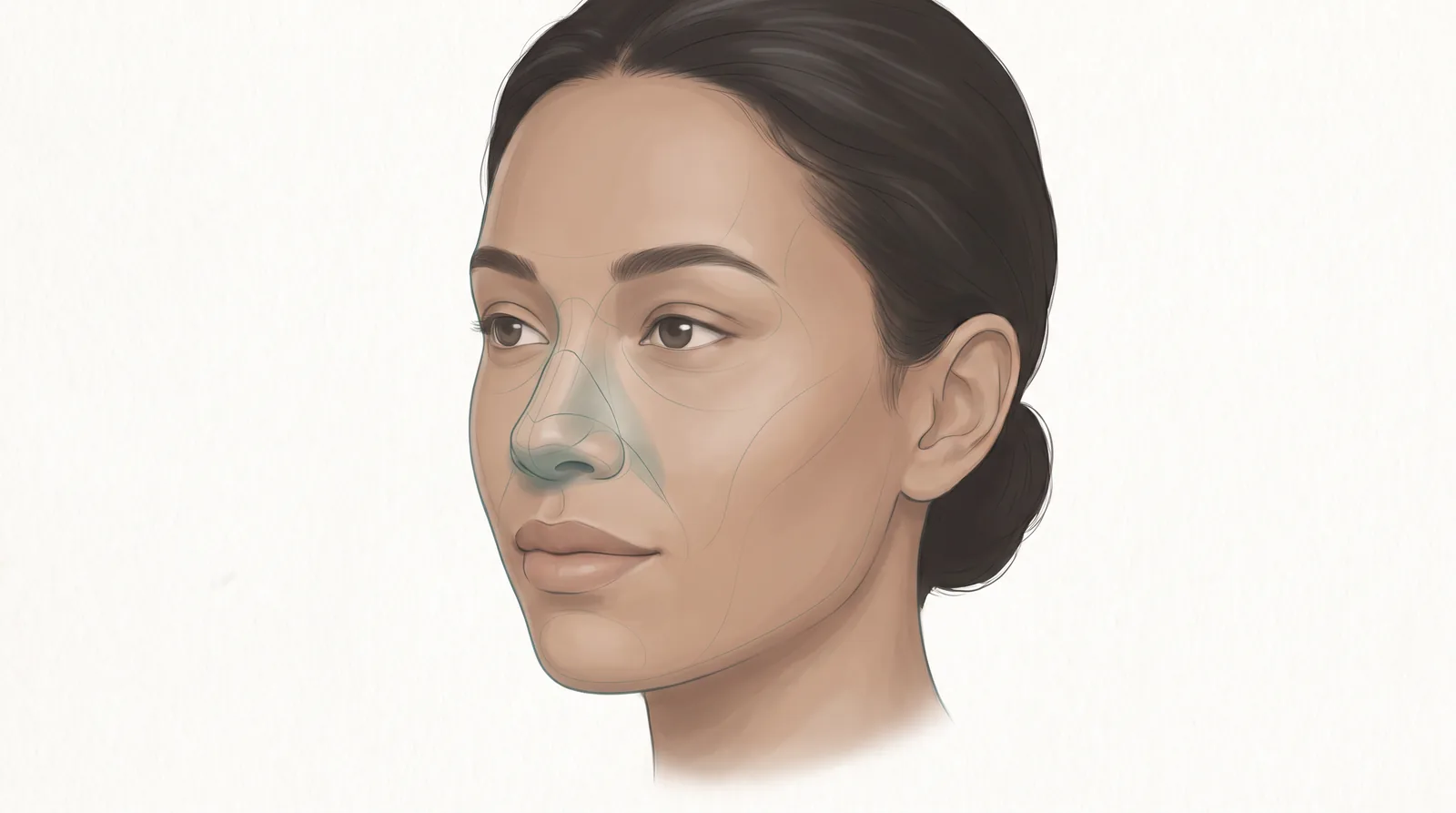
A request for a more refined nasal tip can sound simple, yet the visible tip is not made by cartilage alone. It is the surface result of a living, three-dimensional system: skin, fatty and fibrous soft tissue, the lower lateral cartilages, the nasal septum, and the structures that keep the nostrils open during breathing. The same cartilage shape can look crisp beneath one person’s skin and softly rounded beneath another’s. For that reason, nasal skin thickness is not a minor detail in rhinoplasty planning; it helps define what can be seen, what needs structural support, and what expectations should be discussed before surgery.
Skin thickness is also not a label that applies uniformly to a whole nose. The skin and soft-tissue covering can vary from the bridge to the tip and columella, and its behaviour matters as much as its apparent thickness. Oiliness, pore visibility, tissue firmness, scar tendency, past trauma, inflammation and previous nasal procedures can all influence the assessment. A thoughtful plan therefore begins with anatomy and function, rather than with a promise of a particular tip shape.
Skin Is a Soft-Tissue Envelope, Not a Detail
In rhinoplasty, the skin and the tissue immediately beneath it drape over the rebuilt nasal framework. This covering is often called the soft-tissue envelope. It is the layer through which every change in bone and cartilage must be expressed. It can soften an edge, reveal a small contour difference, or hold swelling for longer than a patient expects. It is not a separate cosmetic layer that can simply be ignored while the framework is changed.
Thinner skin may allow light, shadow and underlying contours to show more clearly. That can make subtle definition more visible, but it can also make minor unevenness, asymmetry or a small edge more apparent. In this setting, meticulous smoothing, symmetry and stable support are particularly important. A plan focused only on making the tip narrower may overlook the need for a smooth transition from the bridge to the tip and from one side to the other.
Thicker or more sebaceous skin may diffuse the contours underneath it. A cartilage framework may be improved while the surface still reads as gentler rather than sharply sculpted. Such skin can conceal very small irregularities, but it may also make fine tip points, narrow shadows and tiny changes less visible. This does not make a person unsuitable for rhinoplasty. It changes the conversation from “How small can the tip become?” to “What balance of refinement, support and natural proportions is realistic for this tissue?”
Importantly, thickness is not the only issue. A medium-thickness envelope can be firm or mobile. A thicker envelope may have different qualities in the supratip region than at the tip itself. Skin quality may be affected by acne, rosacea-like inflammation, sun exposure, smoking or prior surgery. The assessment should be individual and respectful of ethnic features, rather than treating any skin type as a defect or using a single aesthetic template.
How the Tip Framework and Skin Work Together
Under the tip, paired lower lateral cartilages form much of the support and surface architecture. Their curved central portions, often called domes, contribute to the points of light and contour that people describe as tip definition. The medial portions help form the columella between the nostrils, while the lateral portions help support the nostril sidewalls. Their shape, strength, position and relationship to the septum influence projection, rotation, symmetry and airflow.
The skin envelope sits over this framework rather than replacing it. If the cartilages are broad, weak, asymmetric, excessively curved or positioned differently on each side, the visible tip may appear bulbous, boxy, pinched or uneven. Yet those descriptions are surface observations, not diagnoses. A rounded tip can reflect cartilage shape, soft-tissue thickness, the width between domes, nostril anatomy, a low bridge, facial proportions or a combination of factors. Looking at the tip from only one frontal photograph cannot show the full explanation.
A surgeon commonly evaluates the nose from frontal, oblique, lateral and base views, as well as in motion during breathing. The facial midline, chin and upper lip can affect how projection is perceived. The internal septum, nasal valves and sidewalls also matter because a tip that looks narrower but lacks support may compromise airflow. Gentle assessment of tip recoil and nostril stability can add information that a static image cannot provide.
This anatomy explains why “more removal” is not automatically more definition. Removing or weakening cartilage without preserving adequate support can create an unnaturally pinched look, alar retraction, asymmetry or external nasal valve narrowing. Conversely, carefully placed sutures or structural support may be considered in selected cases to refine shape while maintaining stability. The exact method is a surgical decision based on examination, not a universal recipe.
What a Skin-Aware Rhinoplasty Assessment Includes
A useful consultation connects a person’s priorities with the anatomy that can safely support change. It should include a discussion of what is most noticeable to the patient: width, roundness, a downward tilt, asymmetry, nostril show, a profile concern or difficulty breathing. The clinician should also ask about nasal obstruction, allergies, trauma, prior operations, previous injections, medications, medical conditions and smoking or vaping. These details can affect both surgical planning and safety.
External examination considers skin quality, the width and elasticity of the envelope, tip support, cartilage feel, nostril margins and facial balance. Internal examination helps identify septal deviation, valve narrowing, turbinate enlargement or other contributors to obstruction. When breathing is part of the concern, it should not be treated as a separate issue from appearance. A sound rhinoplasty plan aims to avoid sacrificing nasal function for a visual change.
Standardised photographs can help analyse proportions and make the discussion specific. Digital imaging may be useful for communication, but it is a planning aid, not a guarantee or a preview of an exact final result. Light, camera angle, swelling and skin behaviour all affect what a tip appears to be. Similarly, a numerical skin-thickness measurement may contribute information in selected circumstances, but it cannot by itself predict how an individual will heal or how much definition will be visible.
The most valuable outcome of this assessment is often a shared vocabulary. Instead of promising a “sharp” tip, the surgeon and patient can discuss whether the goal is less width, better symmetry, improved support, a more balanced profile or a modest increase in visible definition. That language allows room for the limits of tissue and prioritises proportions that fit the individual face.
Limits, Safety and Realistic Expectations
Rhinoplasty is individualised surgery, not a fixed set of steps. Skin thickness can influence the visibility of contour and the pace at which swelling settles, but it cannot determine an outcome on its own. Cartilage strength, scar response, healing, pre-existing asymmetry, skin quality and breathing anatomy all contribute. No ethical consultation should guarantee tip sharpness, perfect symmetry, a particular appearance at a particular date, or that surgery will eliminate all breathing concerns.
As with other operations, rhinoplasty carries risks. These can include bleeding, infection, anaesthetic reactions, scarring, prolonged swelling or numbness, uneven appearance, changes in breathing, a septal perforation, and the possibility that additional treatment or surgery may be considered. Previous nasal surgery can add complexity because scar tissue and altered support may change the options. People with active nasal or skin inflammation, certain medical conditions, nicotine use, or unrealistic expectations may need treatment, optimisation or more discussion before a decision is made.
Safety begins with a qualified specialist who assesses both the outside and inside of the nose, reviews medical history, explains alternatives and discusses what may not change. Follow-up instructions are personalised. New or worsening breathing difficulty, significant bleeding, fever, severe pain, colour change of the skin, or any other concerning symptom after an operation requires prompt contact with the operating team or urgent medical care as appropriate.
Frequently Asked Questions ### Does thicker tip skin mean I cannot have a more defined tip?
No. Thicker skin does not automatically rule out rhinoplasty or tip refinement. It may mean that subtle contours in the cartilage framework are less visible at the surface and that the goal should be framed as balanced refinement rather than extreme sharpness. The best plan depends on the whole nose, facial proportions, support and breathing assessment.
Why might very thin skin require a different plan?
Very thin skin can reveal fine contours and small irregularities more readily. Planning may therefore place particular emphasis on smooth transitions, symmetry and stable support. It does not mean that a refined result is impossible; it means that every structural change needs careful consideration because it may be more visible.
Can photographs or computer imaging show exactly how my tip will look?
They can support a focused conversation about goals and proportions, but they cannot reproduce healing, swelling, scar behaviour or the way living skin drapes over cartilage. An image should be understood as a communication tool rather than a promise of a precise result.
**Medical notice:** This article provides general education and is not personal medical advice, a diagnosis or a surgical recommendation. Rhinoplasty suitability, technique, risks and expected changes require an in-person assessment by a qualified clinician.
For a personalised discussion of nasal shape, skin characteristics and breathing concerns, visit the rhinoplasty procedure page.