A heavy upper eyelid can be frustrating to describe. Someone may say that their eyes look tired, that makeup disappears beneath a fold of skin, or that they raise their forehead to see more comfortably. It is tempting to assume that the solution must sit in the eyelid. Yet the upper face works as a connected system: the brow provides the upper frame, the forehead muscles can lift that frame, and the eyelid margin and skin move beneath it. A change in one area can alter the appearance and function of another.
That is why responsible planning for upper eyelid surgery begins above the lid. The purpose is not to make every brow higher or to pursue a single ideal shape. It is to identify what is creating the concern in that individual face, document natural asymmetries and discuss options that respect eyelid closure, eye comfort and expression. This assessment can be as important as the procedure itself.
The brow can create the appearance of extra eyelid skin
The eyebrow rests over the bony upper eye socket and supports the soft tissue of the upper face. When part of the brow sits lower, particularly toward its outer tail, the tissue between brow and lashes is compressed. The result can look like an excess of upper-lid skin even when the eyelid skin is not the only, or the principal, issue. Clinicians may describe this as secondary skin hooding.
True upper-eyelid skin redundancy is different. With time, the eyelid skin itself may lose elasticity and form a fold that obscures the natural crease or rests on the lashes. Fullness from fat pads, descent of tissues around the brow, and changes in upper-face volume can also influence the contour. These features often coexist, which is why a single photograph or a quick look in the mirror does not reliably explain the cause.
Brow position is also not judged against a universal beauty template. Brow shape, bone structure, sex, ethnicity, facial proportions, hairstyle and personal preference all affect how an upper face is perceived. A naturally low or straight brow is not automatically a problem. The clinical question is whether its resting position, movement and relationship to the eyelid contribute to a symptom or concern, and what trade-offs any intervention would involve.
A dynamic examination reveals what a still expression may hide
People often lift the brow without noticing. The frontalis muscle in the forehead can raise the brow when a person is trying to clear a visual obstruction or simply compensate for a low lid margin. Persistent recruitment may produce horizontal forehead lines or a feeling of forehead fatigue, but it is not a diagnosis by itself. It is a clue that the examiner should look at the upper face in a relaxed state.
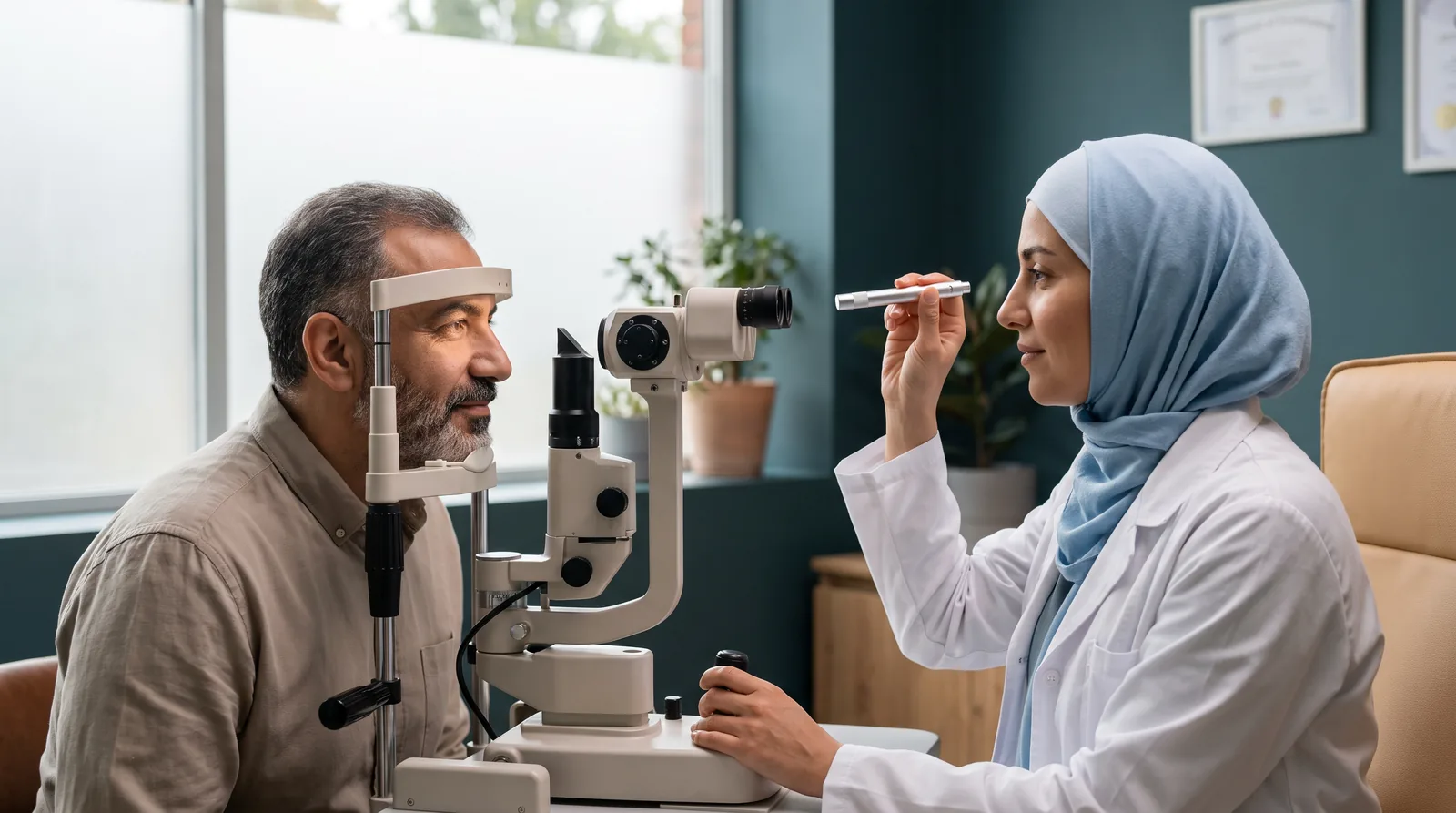
During a consultation, the clinician may observe the face at rest, in primary gaze, while speaking and with gentle brow elevation. They may ask the person to relax the forehead rather than to force the brows down. Comparing these positions can show whether the apparent lid hood changes when muscular compensation is removed. Standardised photographs can help record the starting point, including right-to-left differences, and can make the conversation about realistic change more precise.
This matters because brow height is not static. It changes with concentration, fatigue, expression and muscle activity. One side may be habitually more elevated than the other. A surgeon therefore considers contour and symmetry across the whole brow rather than relying only on the highest central point. The outer brow and the skin at the outer eyelid are especially relevant when a person describes heaviness at the side of the eye.
Measurements may support the examination. Distances between the brow, lid crease, lid margin and corneal light reflex can help record proportion and identify possible ptosis. They are tools for comparison, not a formula that dictates how much tissue should be removed or where a brow should sit. The face must be assessed upright and naturally, not only while reclining or posing.
Four findings that should not be treated as the same problem
Several conditions can create a similar “heavy-eye” impression, but they are not interchangeable. **Dermatochalasis** means lax or redundant eyelid skin. **Brow ptosis** refers to a brow that rests lower than is appropriate for that person’s anatomy and goals. **Blepharoptosis**, often shortened to ptosis, means that the upper eyelid margin itself sits low over the eye. A fourth contributor can be upper-face volume or soft-tissue contour.
The distinction is practical. Removing a fold of eyelid skin does not raise a low lid margin. It also does not automatically reposition a brow or replace lost volume. Conversely, changing brow support may not solve all true eyelid-skin redundancy. Some people have more than one contributor and may be offered a discussion of combined, staged or non-surgical approaches. Others may find that no procedure is the appropriate answer.
A thorough assessment also checks the health of the eye, not only its appearance. Relevant questions include dry, gritty or watery eyes; contact-lens use; blink habits; prior eye or facial surgery; facial trauma; thyroid or neuromuscular conditions; and medicines or supplements that may affect bleeding or healing. The examination can include lid closure, tear film, corneal surface, eyelid movement and levator function. If there are visual symptoms, formal visual-field testing may be considered with the forehead relaxed and the person looking straight ahead.
Existing asymmetry deserves a direct conversation. Almost no face is perfectly matched from side to side. One brow may be lower, one lid crease may be different, or one eyelid margin may sit lower before any treatment. Identifying this early helps avoid the misleading expectation that surgery can produce mathematical symmetry. The aim is a proportionate, safe result that fits the person’s natural face, not a copied brow position.
How assessment informs the discussion of options
After the components are separated, the consultation can become more useful. If eyelid skin is the main contributor and brow position is stable, upper blepharoplasty may be the procedure discussed. If a low lid margin is a major finding, ptosis repair may need its own discussion. If brow descent is substantially shaping the upper-lid hood, brow support or lifting may be considered, sometimes alongside an eyelid procedure and sometimes not.
These are planning categories, not self-diagnoses. The choice depends on anatomy, eye-surface health, function, prior treatments, goals, scar tolerance and the person’s willingness to accept specific recovery and risk considerations. A person who wants a subtle change may reasonably make a different choice from someone whose priority is visual function. It is also reasonable to defer surgery while an eye-surface problem, unstable medical condition or unresolved expectation is addressed.
A useful consultation does more than recommend a technique. It clarifies what each option is intended to change and what it cannot change. For example, upper eyelid surgery may reduce an eyelid fold, but it does not stop facial ageing or guarantee a particular brow contour. Brow-directed treatment may alter the frame above the eye, but it cannot promise identical sides or erase every forehead line. Reviewing old photographs can sometimes help distinguish a person’s long-standing features from newer changes, while still recognising that old images are not a surgical blueprint.
Treatment limits and safety considerations
Upper-face procedures require restraint because the eyelids protect the eye. Removing too much skin or failing to account for a low brow, low lid margin or dry-eye tendency can compromise comfortable closure or leave a result that does not match the preoperative plan. Blepharoplasty and brow procedures also cannot treat every cause of a tired appearance, headache, facial asymmetry or reduced vision. A separate eye condition may require assessment by an eye-care professional.
All surgery carries risk. Depending on the procedure and individual factors, this can include bleeding, infection, scarring, prolonged swelling, numbness or altered sensation, asymmetry, undercorrection or overcorrection, changes in brow position, dry-eye symptoms, difficulty closing the eyes and a need for further treatment. Serious eye complications are uncommon but can be urgent. After any eyelid operation, severe pain, a sudden change in vision, rapidly increasing swelling, marked protrusion of the eye or persistent heavy bleeding should prompt urgent medical attention.
Safety planning includes accurate medical history, appropriate examination, clear medication instructions from the treating team and realistic consent. It should never be replaced by an online image comparison or a promise that a certain technique will suit everyone.
Frequently Asked Questions ### Why does relaxing the forehead matter before upper eyelid surgery?
A raised forehead can temporarily lift the brow and make the amount or source of lid hooding look different. Observing the face with the forehead relaxed helps distinguish habitual muscle compensation from the underlying relationship between brow, eyelid skin and lid margin. It does not determine treatment by itself, but it improves the quality of the conversation and the plan.
If one brow is lower, does that mean both sides should be treated identically?
Not necessarily. Natural left-right differences are common, and identical movements on both sides do not always create a balanced appearance. A clinician documents the asymmetry, evaluates its cause and discusses what degree of improvement is realistic. The plan, if any, is individual rather than based on a mirrored template.
Can upper eyelid surgery make a low brow more noticeable?
It can change how the brow–lid relationship is perceived, particularly when a person had been lifting the brow to compensate for heaviness. Research findings on postoperative brow change are not uniform, which is one reason the brow should be assessed and discussed beforehand. Careful planning aims to avoid surprises, but it cannot guarantee a particular postoperative brow position.
**Medical disclaimer:** This article is general education, not personal medical advice, a diagnosis or a recommendation for surgery. Assessment of eyelid and brow concerns should be performed in person by a qualified clinician who can examine the eyes and medical history.
For a personalised discussion of upper-eyelid concerns and the broader upper-face assessment, visit our eyelid procedure page.