Introduction
A breast operation leaves an incision because the skin has to be opened and closed. That incision becomes a scar as the body repairs itself. Whether surgery is an augmentation, lift, reduction, implant exchange, reconstruction or a corrective procedure, it is more realistic to plan for a scar that changes than to expect a scarless result.
The useful question before surgery is not simply, “Where can the scar be hidden?” It is how the incision plan supports the safe performance of the operation, the desired breast shape and nipple position, tissue handling, and a closure that is not under unnecessary tension. A well-considered plan may place lines along an areolar border, vertically on the lower breast, in the breast crease, or in another location appropriate to the operation. Each choice has a trade-off. A shorter line is not automatically the better plan if it limits the surgeon’s ability to do the procedure safely or reliably.
Scars also deserve patience. A new line can look darker, pinker, firmer, itchy or uneven while it is active. Its colour and feel can fluctuate. Later, it may soften and become less conspicuous, but it does not disappear completely and no clinician can predict its final appearance with precision. This guide explains how incision planning, scar maturation and sensible aftercare fit together, without treating any one technique or product as a guarantee.
Incision planning: the operation comes first
Incision placement is a design decision, but it is first a surgical decision. It is determined by the procedure’s purpose, the amount and quality of skin, breast shape and symmetry, nipple position, whether an implant or a breast implant pocket is involved, any previous scars, and any reconstructive needs. The surgeon may also consider how a line sits against the natural fold of the breast, the edge of the areola, or the lower-breast contour. These locations can make a scar less obvious in some clothing or positions, but they cannot make it invisible in every posture or lighting condition.
For example, an augmentation may use an incision at the lower breast crease or around part of the areola in selected cases. A lift or reduction often needs more than one line because skin and breast tissue may need to be reshaped and the nipple-areola complex repositioned. A periareolar pattern circles the areola; a vertical pattern adds a line down to the crease; an anchor pattern includes a line in the crease as well. Reconstruction and revision surgery can involve a different pattern, particularly if prior scars, radiotherapy, tissue loss or implant issues need to be considered.
The plan should be discussed before the operation, not discovered afterwards. Ask the surgeon to explain the intended line with a drawing or mirror, why it is recommended for your anatomy, and whether an existing scar can be used or must be extended. It is also reasonable to ask where the line may be visible in swimwear, a low neckline, or when the arms are raised. The answer should describe possibilities rather than promise concealment.
Tension matters as much as location. Skin that is closed under more tension may be more prone to widen, remain raised, or feel tight while it heals. Surgeons use techniques to support the deeper tissues and reduce tension on the skin, but the body’s response, swelling, movement and wound healing still affect the result. A person’s previous scars can be informative. Tell the surgeon if you have formed a thick, itchy or expanding scar after an injury, piercing, vaccination or past surgery, or if close relatives have a history of keloids. That information helps set expectations and can guide the follow-up plan.
Scar maturation: a changing biological process
A scar is not “finished” when stitches, tape or dressings are removed. It develops as inflammation settles, the wound gains strength and collagen is reorganised. In the early phase, a line can be red or purple, a little swollen, firm, tender, numb, itchy or irregular. Small changes in temperature, activity and swelling can make it look different from day to day. These features are not, on their own, proof that a scar will remain prominent.
Over a longer and highly variable period, many scars flatten, soften and fade toward a lighter or darker tone than the surrounding skin. Maturation often takes many months and may continue beyond a year. This is why early judgement can be misleading and why an immediate “fix” is not always the safest response. A result should be assessed at appropriate follow-up visits, in the context of the wound’s health and the original procedure.
Skin tone, genetics, age, nutrition, smoking or nicotine exposure, infection, wound separation, medical conditions, medicines and prior radiotherapy can influence healing. Some variables are modifiable and some are not. Even two scars on the same person may mature differently. Darkening after sun exposure and pigment change are particular concerns for all skin tones. A scar can remain visible even when it has healed well.
It is helpful to know the difference between two raised-scar patterns. A hypertrophic scar is raised but stays within the original incision boundary. A keloid extends beyond that boundary and may keep growing. Neither should be self-diagnosed from a photograph. If a healed line becomes increasingly thick, very itchy, painful, red or extends outside its original outline, contact the surgical team or a qualified clinician. They can decide whether observation, silicone-based care, pressure or another supervised treatment is appropriate.
Aftercare: protect the closure before treating the scar
The first priority is the incision, not cosmetic scar treatment. Use the dressing, support garment, bra, tape, showering routine and activity plan given by your own surgical team. These instructions vary by operation, closure method and personal medical factors. Do not pull off adhesive strips, scrub the incision, apply creams, oils, acids, bleaching agents or home remedies, or begin massage simply because a calendar date has passed. A product that is reasonable for fully closed skin may be unsuitable for a fresh or irritated wound.
As activity resumes, lifting, repetitive arm movements and strenuous exercise can place traction on breast incisions. The safest progression is the one specified by the operating team. Arrange practical help if possible, especially for lifting, household tasks and childcare. Avoiding nicotine is also important for wound healing. If smoking cessation support is needed, ask for it before surgery rather than relying on willpower during recovery.
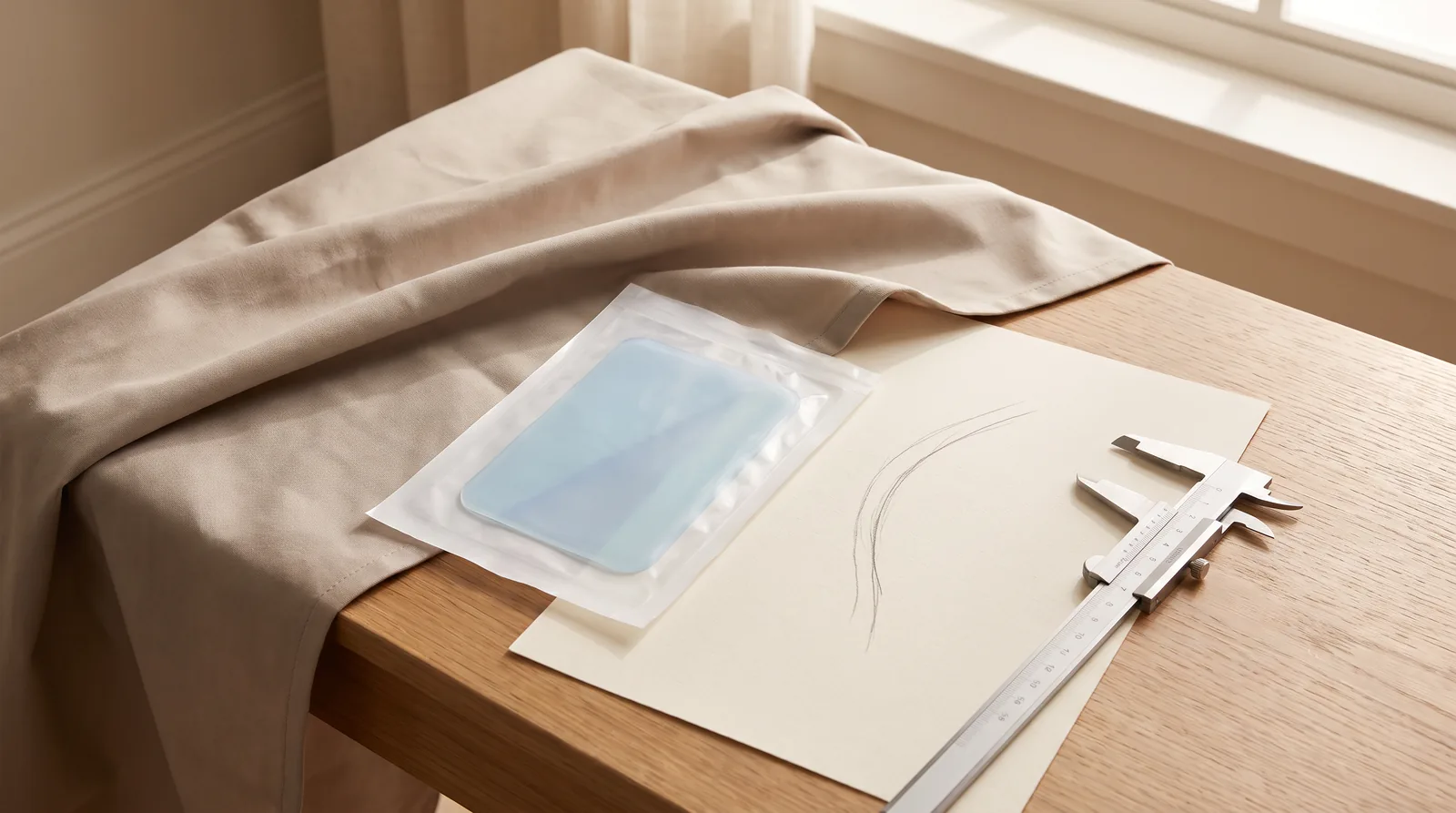
Once the incision is completely closed and the surgeon approves it, a tailored scar-care plan may include silicone gel or sheets, paper tape, moisturising or gentle massage. These approaches are not interchangeable, and the start point, technique and duration should be individualised. Silicone has a reasonable evidence base for some scars, while the claims made for many oils, vitamin preparations and over-the-counter “scar erasers” are much less certain. More products do not mean better healing, and irritation can create a new problem.
Protection from ultraviolet exposure is a simple but important long-term habit. New scars may pigment differently after sun exposure. When the area will be exposed and the incision is fully healed, follow your team’s advice on covering it with clothing and using broad-spectrum sun protection. Sun protection is not a bleaching treatment, but it can help avoid avoidable colour change while the scar is maturing.
Keep scheduled reviews even if the wound looks settled. Bring questions about soreness, tightness, altered sensation, a pulling feeling, uneven scar edges or asymmetry to the appointment. Photographs can be useful for monitoring change when taken privately in consistent lighting, but they cannot replace an examination. Do not compare a healing scar to an edited online image or assume someone else’s recovery timeline applies to you.
Treatment limits and safety
Scar care can support healing and may improve comfort, texture or colour for some people; it cannot erase an incision or guarantee a specific appearance. No cream, dressing, massage method, laser, injection or revision operation is right for every scar. Procedures intended to improve a mature scar also have limitations and potential effects, including pigment change, irritation, recurrence or a new scar. A clinician will weigh these against the benefit and usually considers the health and maturity of the scar before recommending a procedure.
Contact the treating surgeon or their on-call service promptly if there is increasing rather than settling redness, warmth, swelling, pain, a wound that opens, bleeding, cloudy or foul-smelling fluid, fever, or a general feeling of illness. Seek urgent medical care for severe symptoms or if you cannot reach the surgical team. These symptoms require assessment; they should not be managed by adding a scar product at home.
**Medical notice:** This article provides general education and is not a diagnosis, a personalised aftercare plan or a substitute for advice from your surgeon. Follow the written instructions provided for your operation. Tell your clinician about allergies, medicines, diabetes, nicotine use, previous radiotherapy and any history of abnormal scarring before using a treatment or changing wound care.
Frequently Asked Questions ### Can a breast-surgery scar be completely removed?
No. An incision heals by forming scar tissue, so the realistic aim is a healthy, settled and less noticeable line rather than no line at all. Its eventual visibility varies with the operation, incision pattern, skin biology, healing events and aftercare. If a mature scar remains troubling, a specialist can discuss whether an observation period or a supervised treatment is reasonable; no option promises complete removal.
When can I start silicone, massage or a scar cream?
Only after the incision has fully closed and your own surgeon or nurse says it is appropriate. The safe timing differs between patients and procedures. Starting too early, applying a product to open or irritated skin, or massaging a vulnerable closure can interfere with healing. Ask the team which product, if any, they recommend and how to use it.
Does a longer incision always mean a worse scar?
Not necessarily. A longer or differently shaped incision may be needed to perform a lift, reduction, reconstruction or revision accurately and without excessive tension. Scar quality depends on healing as well as length. The most useful discussion is why a particular pattern serves the procedure and what visibility is realistic for your body and goals.
If you are considering a breast procedure or want a clinician to assess a postoperative concern, arrange a consultation through Almanara Emirates Breast Procedures.